Category: Sports

  • Firearm Training for Everyone – Choosing the Right Course for Your Needs

    Firearm Training for Everyone – Choosing the Right Course for Your Needs

    In today’s world, firearm training has become increasingly important for a variety of reasons, including personal safety, recreational shooting, and professional development. Whether you are a novice looking to handle firearms safely for the first time or an experienced shooter wanting to hone your skills, the right firearm training course can make all the difference. This article aims to guide you through the options available and help you choose the best training course for your needs.

    Understanding the Basics of Firearm Training

    Firearm training encompasses a wide range of subjects, including gun safety, handling techniques, marksmanship, and the legal aspects of gun ownership. The core objective of any firearm training course is to promote safe and responsible gun ownership. It is crucial for participants to learn about the mechanics of firearms, proper handling, and the importance of respecting both the weapon and those around them.

    Before enrolling in a course, it’s vital to consider what you hope to achieve from your training. Different courses are designed for different skill levels and objectives. Knowing your goals will help narrow down your options.

    Types of Firearm Training Courses

    1. Basic Safety Courses: Ideal for beginners, these courses focus on the fundamentals of firearm safety. Participants learn how to handle guns safely, store them properly, and understand the basic mechanics of various firearms. Many states require completion of a basic safety course before obtaining a firearm license.
    2. Intermediate and Advanced Courses: Once you have grasped the basics, you may want to take your skills to the next level. Intermediate courses often cover more complex shooting techniques, including tactical shooting and target acquisition. Advanced courses may include scenarios that simulate real-life situations, challenging participants to make quick decisions under pressure.
    3. Specialized Training: For those with specific interests, there are specialized courses available. These may include self-defense training, competitive shooting, or courses tailored for law enforcement and military personnel. Specialized training often requires prior knowledge and experience, so it’s crucial to assess your current skill level before enrolling.
    4. Online Training: In recent years, online firearm training has gained popularity, especially for those who prefer learning at their own pace. While online courses can provide valuable information on safety and regulations, hands-on practice is essential for mastering firearm handling. Therefore, consider complementing online courses with practical training sessions at a shooting range.

    Factors to Consider When Choosing a Course

    When selecting a firearm training course, several factors should guide your decision:

    • Instructor Qualifications: Look for courses taught by certified instructors with extensive experience in firearm training. They should possess not only technical knowledge but also the ability to communicate effectively and ensure a safe learning environment.
    • Course Content: Review the syllabus to ensure the course covers the topics you are interested in. Some courses may focus heavily on safety, while others may emphasize shooting techniques or legal considerations. Choose one that aligns with your goals.
    • Location and Facilities: Consider the location of the training facility and the availability of shooting ranges. A reputable training center will have access to safe, well-maintained facilities and resources that enhance the learning experience.
    • Class Size: Smaller class sizes often allow for more personalized instruction and feedback. In contrast, larger classes may provide a broader range of perspectives but can limit individual attention.
    • Reviews and Recommendations: Research online reviews and ask for recommendations from friends or family who have completed firearm training courses. Their experiences can provide valuable insight into the quality of instruction and overall satisfaction.

    Conclusion

    Firearm training is an essential component of responsible gun ownership and can greatly enhance your skills and confidence as a shooter. By understanding the various types of training available and considering your specific needs and goals, you can choose the right course for you. Whether you’re a beginner seeking to learn the basics or an experienced shooter looking to refine your techniques, the right firearm training course can equip you with the knowledge and skills necessary to handle firearms safely and effectively. Embrace the journey of learning, and enjoy the empowerment that comes with being a knowledgeable and responsible gun owner.
  • Let’s discuss the difference between a Pickleball Court vs. Tennis Court 

    Let’s discuss the difference between a Pickleball Court vs. Tennis Court 

    1. As outdoor sports continue to rise in popularity, both pickleball and tennis have become fan favorites. While the two sports share similarities, their court designs, surface requirements, and overall gameplay vary significantly. One of the most critical elements for both is the court surface itself. At Pacecourt, we focus on acrylic flooring for outdoor courts, providing durable, high-performance surfaces tailored to both pickleball and tennis. We are going to explore the sports difference pickleball court vs. tennis court.

    In this post, we’ll explore the differences between pickleball and tennis courts, why acrylic flooring works for both, and how it enhances gameplay, safety, and longevity.

    1. Pickleball Court vs. Tennis Court: The Basics

    1.1 Court Size and Layout

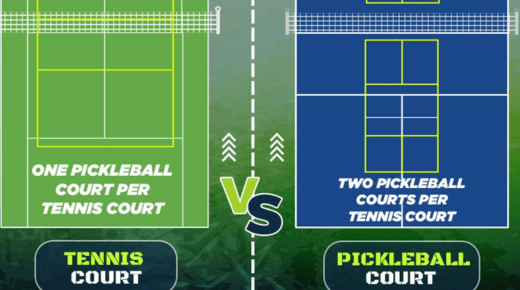
    The most noticeable difference between a pickleball court and a tennis court is size. A standard tennis court measures 78 feet in length and 36 feet in width for doubles, with singles courts being 27 feet wide. By contrast, a pickleball court is much smaller, measuring 44 feet in length and 20 feet wide.

    These size differences are important when it comes to game pace and movement. Pickleball’s smaller court size results in quicker exchanges and more strategic, finesse-based play, while tennis involves longer rallies and a wider range of movement.

    Why it matters:
    A smaller pickleball court means more emphasis on precision, while tennis players benefit from a larger playing area that allows for power and speed. For both, a smooth, consistent surface is key, making acrylic an ideal choice.

    1.2 Net Height and Equipment

    The net height also differs between the two sports. A tennis net stands at 3.5 feet at the posts and 3 feet in the center, while a pickleball net is slightly lower at 3 feet at the posts and 2.875 feet at the center. This lower net height for pickleball leads to faster ball exchanges at closer distances, whereas tennis players have more leeway for higher, angled shots.

    Both sports rely on well-marked court lines for gameplay precision. For pickleball, these lines are smaller and more compact, reflecting the smaller court size. Tennis, with its longer baseline, requires clear visibility for its wider angles and lengthier rallies.

    2. Why Acrylic Flooring is Perfect for Both Pickleball and Tennis Courts

    Acrylic flooring has become a preferred surface for outdoor sports courts, especially for pickleball and tennis, because it offers durability, comfort, and performance.

    2.1 Consistency and Playability

    One of the most important aspects of any court surface is the consistency it provides. Acrylic surfaces are known for offering a true, predictable ball bounce, which is essential for both pickleball and tennis players. This helps players anticipate how the ball will react, improving gameplay quality.

    In pickleball construction, with its fast-paced, reaction-based gameplay, having a court surface that ensures a consistent bounce is critical. For tennis players, where spin and angles often define play, acrylic surfaces allow for more strategic shots, minimizing unpredictable bounces.

    2.2 Player Comfort and Safety

    Both pickleball and tennis involve quick directional changes, rapid starts and stops, and high-impact footwork. Acrylic sports flooring provides a cushion that helps absorb impact, reducing the strain on players’ joints, which is especially important for older players who gravitate towards pickleball.

    Acrylic also offers the right amount of traction, preventing slips without hindering movement. Whether you’re diving for a volley in pickleball or sliding into a shot in tennis, this type of surface enhances player safety by minimizing the risk of falls or injuries.

    2.3 Durability and Weather Resistance

    Acrylic surfaces are built to withstand the elements. Outdoor courts endure constant exposure to UV rays, rain, and fluctuating temperatures, all of which can wear down inferior surfaces. Acrylic flooring, however, is UV-resistant and can handle weather-related wear and tear without cracking or fading.

    For both pickleball and tennis, court surfaces need to be durable and weather-resistant to maintain a high level of play throughout the year. Acrylic’s longevity means less maintenance over time, making it an ideal choice for both private and public courts.

    4. Transitioning Between Pickleball and Tennis Courts: How Acrylic Flooring Helps

    Many facilities and recreational centers look to maximize their space by offering both pickleball and tennis courts. In some cases, multi-use courts are created, with different line markings for each sport. Acrylic flooring is ideal for these multi-use spaces because it can be easily customized to include markings for both sports, without sacrificing surface quality.

    Additionally, the longevity and low-maintenance nature of acrylic flooring make it a cost-effective solution for facilities that offer both sports. The ability to withstand heavy use without deteriorating ensures that both pickleball and tennis players have access to high-quality courts throughout the year.

    5. Conclusion: Choose Acrylic Flooring for Superior Pickleball and Tennis Court Performance

    While pickleball and tennis may differ in their court size, equipment, and gameplay, they share one important requirement—a durable, consistent surface that enhances player experience. With its balance of performance, comfort, and durability, acrylic flooring is the best solution for outdoor courts that cater to both sports.

    Whether constructing a new court or resurfacing an existing one, acrylic provides the playability, safety, and weather resistance that both pickleball and tennis players demand.