

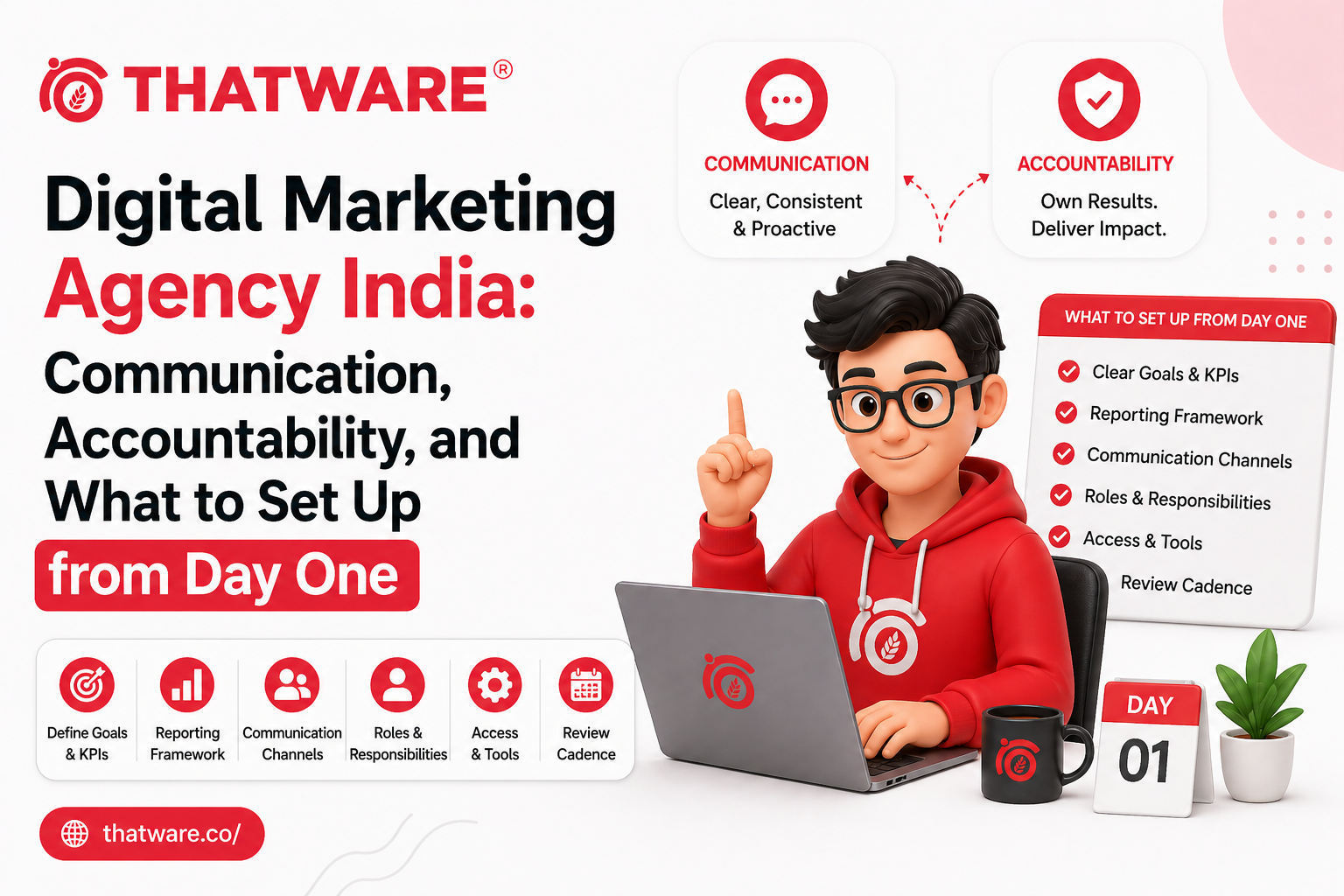
The decision to partner with an Indian digital marketing agency often makes excellent sense on paper. The talent is genuinely strong at the top end of the market. The cost structures allow you to access capabilities that would be significantly more expensive domestically. The time zone, while different, is workable with the right communication setup.…
On this page
The decision to partner with an Indian digital marketing agency often makes excellent sense on paper. The talent is genuinely strong at the top end of the market. The cost structures allow you to access capabilities that would be significantly more expensive domestically. The time zone, while different, is workable with the right communication setup. But the engagements that fail — and there are more of those than the industry likes to acknowledge — almost always fail for the same set of reasons: unclear expectations at the start, communication norms that weren’t established deliberately, and accountability structures that didn’t survive the first difficult conversation. The right digital marketing agency india partnership doesn’t just happen because the agency is capable. It gets built intentionally. And the digital marketing services that deliver long-term value are the ones where both sides invested in the relationship architecture from day one.
Here’s what that looks like in practice.
The Kickoff That Actually Sets the Tone
Most client-agency kickoffs focus on deliverables, timelines, and tools. The agencies with the best long-term client relationships do more than that. They also establish norms.
What does a typical week of communication look like? Who is the primary point of contact on both sides? What’s the expected response time for routine questions versus urgent matters? What is the escalation path when something goes wrong? What decisions can the agency make independently, and what requires client sign-off?
These questions feel process-heavy in the excitement of a new engagement. They feel essential three months in when something unexpected happens and there’s no established protocol for handling it.
The best kickoffs cover all of this explicitly and document the outcomes. Not in a 50-page contract addendum, but in a simple working agreement that both teams can reference. One page. The kind of thing that actually gets read and followed rather than filed and forgotten.
Structured Communication Rhythms
Ad hoc communication doesn’t scale well across time zones. When the client is in London and the agency is in Bangalore, “just ping me whenever” creates an 11.5-hour communication gap that turns small misunderstandings into multi-day delays.
The rhythm that works: a weekly async update (structured report sent at the same time each week, covering what was done, what’s in progress, what needs client input, and any blockers), a biweekly or monthly video call for strategic discussion and relationship maintenance, and a clear channel distinction between urgent (same-day response expected) and routine (48-hour response acceptable) communication.
The async update is underrated. It creates a weekly paper trail of accountability, forces the agency to articulate what they actually did and why, and gives the client a predictable touchpoint that doesn’t require scheduling. Teams that skip it always find themselves with worse communication quality within a few months.
Setting Meaningful KPIs (Not Just Activity Metrics)
Digital marketing agencies love activity metrics because activity is controllable. Posts published, ads run, emails sent, keywords optimized — these are outputs the agency controls completely and can report on with confidence.
The problem is that activity doesn’t equal results. An agency can be impressively busy and be moving the needle on nothing that matters to your business.
Meaningful KPIs connect agency activity to business outcomes. Organic traffic growth among target audience segments, not just total sessions. Qualified leads generated, not just form fills. Cost per acquisition, not just cost per click. Brand search volume growth as a proxy for awareness investment paying off.
Setting these KPIs requires having an honest conversation about what the agency can actually influence. Some outcomes take six months to show up. Some depend on client-side factors (conversion rate on the website, sales team follow-up speed) that the agency doesn’t control. The conversation where you work through this honestly is worth having early, even if it’s uncomfortable.
The Difficult Conversation Protocol
Every engagement eventually hits a difficult moment. A strategy that isn’t working. A deliverable that missed the mark. A result that fell short of projections. How both parties handle that moment determines whether the engagement continues to be valuable or starts its decline.
The agencies worth working with have a clear protocol: they surface problems proactively rather than hoping you won’t notice, they come with proposed solutions rather than just problem statements, and they’re honest about uncertainty when they don’t yet know why something isn’t working.
The clients worth working with respond to difficult news with curiosity rather than blame, give the agency space to course-correct before demanding accountability, and maintain the relationship investment even when results are temporarily disappointing.
Neither side gets this right automatically. It’s a norm that gets established, tested, and reinforced over time. The kickoff is where you set the expectation that this is how difficult conversations will go. The first difficult conversation is where you either prove it or undermine it.
Intellectual Property and Work Product
One of the more consequential practical questions in digital marketing services relationships is who owns the work product. Content produced, campaign creative, strategy documents, custom tooling or templates developed during the engagement — these have real value, and their ownership status should be explicit.
The standard approach: strategy and proprietary process documentation generally stays with the agency, while client-specific content, assets, and campaigns become client property. But “generally” is doing a lot of work in that sentence. The specific terms should be clear before you sign anything, and should cover what happens to work in progress if the relationship ends unexpectedly.
Getting this documented upfront is much easier than trying to sort it out at the end of a contentious offboarding. The conversation is brief. The clarity is valuable.